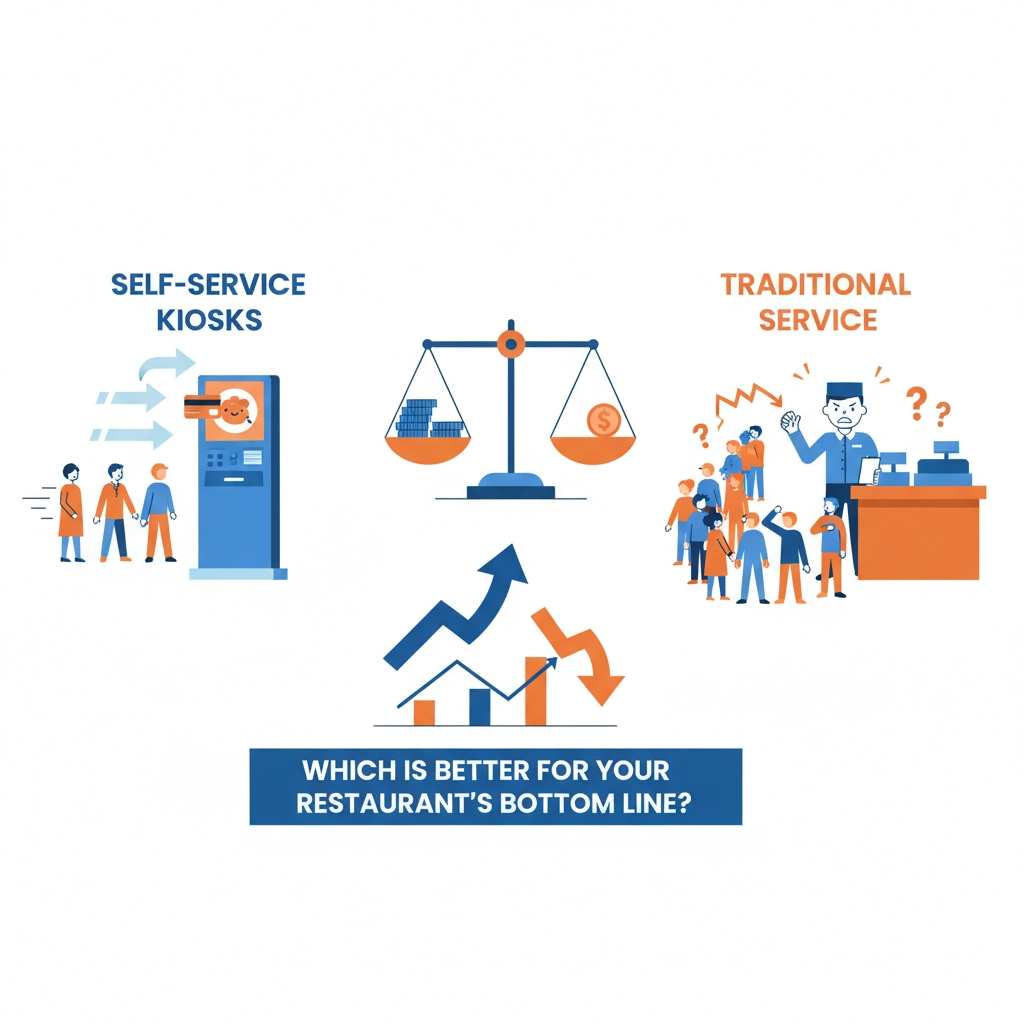
The restaurant industry is experiencing the biggest shift in customer service since the invention of the cash register: and the numbers don’t lie. Self-service kiosks are delivering 8-15% higher transaction values and 30% reductions in labor costs compared to traditional counter service. But is this digital revolution actually better for your restaurant’s profitability, or just another expensive tech trend? Let’s break down the real financial impact, because your bottom line depends on making the right choice.
The Revenue Reality Check
When Shake Shack reported that over 50% of their in-store sales now come through kiosks, it wasn’t just a feel-good tech story: it was a profit revolution. Here’s what the numbers actually show: Traditional Service Revenue Pattern:
- Average ticket: $10-12
- Upsell success rate: 15-25% (highly dependent on staff training and mood)
- Daily transaction volume: Limited by cashier speed and availability
Self-Service Kiosk Revenue Pattern:
- Average ticket: $11.50-14 (8-15% increase)
- Upsell success rate: 35-45% (algorithm-driven suggestions)
- Daily transaction volume: 40% faster processing times

Real Example: A mid-size restaurant generating $5,000 daily from 500 transactions could see revenue jump to $6,440 per day with kiosks. That’s an extra $525,600 annually: enough to pay for the kiosk system several times over. The secret? Kiosks never get tired of suggesting upgrades, add-ons, and premium options. They don’t worry about seeming pushy or forget to mention the dessert special.
Labor Cost Analysis: The Brutal Truth
Traditional service model labor costs:
- 2-3 full-time cashiers per shift
- Training costs for high-turnover positions
- Scheduling complexity during peak hours
- Human error in order taking and processing
Kiosk-enhanced model:
- 30% reduction in front-of-house staffing needs
- Reallocation of staff to food prep and customer experience
- Consistent performance during rush periods
- Minimal ongoing training requirements
A three-location ramen chain eliminated one cashier position per location after installing kiosks, saving $1,050 per week. A burger restaurant saved $499 weekly by reducing front-counter staff. The math is simple: Even with a $50,000-$100,000 kiosk implementation cost, most restaurants achieve ROI within 3-6 months. Some see returns in as little as 4-5 days.

Customer Experience: What Actually Matters
Here’s where traditional wisdom gets challenged. Many restaurant owners worry that removing human interaction will hurt customer satisfaction. The data tells a different story: Customer preference breakdown:
- 65% of kiosk users are more likely to return
- 78% appreciate shorter wait times during peak hours
- 82% prefer controlling their own order customization
- Gen Z customers actively seek out kiosk-enabled locations
Traditional service advantages:
- Personal connection and hospitality
- Ability to handle complex questions or special requests
- Flexibility for menu modifications
- Building regular customer relationships
The winning strategy isn’t choosing one over the other: it’s strategic combination.
The Hybrid Model: Best of Both Worlds
Smart restaurants are implementing kiosk-first, human-supported service models: Kiosks handle:
- Standard orders and transactions
- Upselling and cross-selling
- Payment processing
- Order customization
Staff focus on:
- Greeting and welcoming customers
- Handling complex requests
- Food quality and timing
- Problem resolution and customer care

This approach captures kiosk efficiency gains while maintaining the human touch that builds loyalty.
Implementation Reality: What It Actually Costs
Initial Investment Breakdown:
- Hardware: $3,000-$10,000 per kiosk
- Software licensing: $50-$200 monthly per unit
- Installation and setup: $2,000-$5,000
- Staff training: $500-$1,500
- Integration with existing POS: $1,000-$5,000
Ongoing Costs:
- Monthly software fees
- Maintenance and support
- Periodic hardware updates
- Payment processing fees
Break-even timeline: 3-6 months for most implementations, based on combined revenue increases and labor savings.
When Traditional Service Still Wins
Kiosks aren’t the answer for every restaurant concept: Stick with traditional service if:
- You operate fine dining or upscale casual concepts
- Your average ticket is already above $30
- Customer education about complex menu items is crucial
- Your brand differentiator is exceptional personal service
- Your customer base skews significantly older
Your menu requires extensive explanation or customization beyond standard options.
The Competitive Advantage Factor
Restaurants implementing kiosks report 20% improvements in order accuracy and significantly reduced wait times. During labor shortages, kiosk-enabled restaurants maintain consistent service levels while competitors struggle with staffing.

Market positioning benefit: Restaurants with modern ordering systems appear more innovative and attract tech-savvy customers who increasingly expect digital convenience.
Making the Decision: Your Bottom Line Calculation
Choose kiosks if:
- Your priority is maximizing profitability
- You’re operating in a high-volume, fast-casual environment
- Labor costs are squeezing your margins
- You want consistent upselling performance
- Your customer base includes significant Gen Z/Millennial segments
The Rise of Self-Service Kiosks
Enhance with traditional service if:
- Customer experience differentiation is your competitive advantage
- You serve an older demographic preferring personal interaction
- Your menu complexity requires explanation
- Building regular customer relationships drives repeat business
The Verdict
Self-service kiosks deliver superior financial results for most restaurant operations. The combination of 8-15% higher transaction values, 30% labor cost reductions, and 3-6 month ROI timelines makes them a clear winner for bottom-line improvement. However, the highest-performing restaurants use kiosks strategically: handling high-volume transactions while freeing staff to focus on hospitality and complex customer needs. The future isn’t human versus machine; it’s optimizing both for maximum profitability and customer satisfaction. Your bottom line will thank you for making the data-driven choice, not the emotional one.